Same Dish, Five Kitchens: Following Chicken and Dumplings Across State Lines
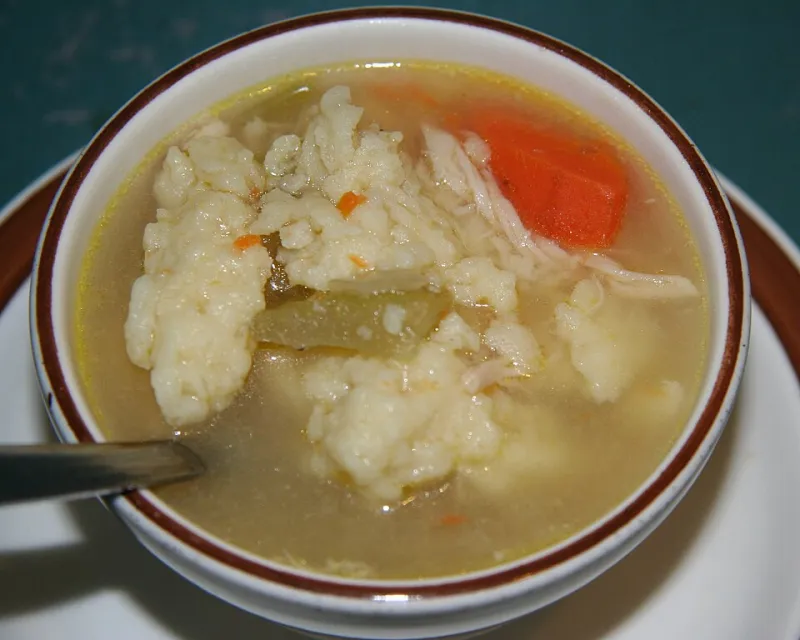
Photo: Jonathunder, CC BY-SA 3.0, via Wikimedia Commons
The Recipe That Won't Sit Still
There's a myth we like to tell about heirloom recipes: that they're passed down intact, like a piece of jewelry in a velvet box. Grandma wrote it on a card, Mom kept it in the tin, and someday it lands in your kitchen exactly as it began.
Anyone who's actually cooked beside a relative knows better. Recipes move the way families move—by car, by train, by U-Haul—and they pick things up along the way. A new grocery store. A new neighbor. A new climate that makes the old one seem impossibly cold.
So we ran a little experiment. We found five home cooks in five states who all claimed to make their grandmother's chicken and dumplings. Same dish. Same name on the recipe card. Five completely different pots.
Tennessee: The Flat Dumpling Standard
Dorothy, 74, outside Knoxville, learned from her mother, who learned from a neighbor on the same holler road. Her dumplings are rolled thin, cut into squares, and laid into the broth one by one so they fuse into something closer to a rich, slicked noodle casserole than a soup.
"You don't stir," she told me on the phone, like she was scolding a child. "You slide them in and you leave them be."
Her version is the Appalachian baseline: a whole chicken simmered for hours, pepper-heavy broth, nothing green anywhere near it. When her family moved to Detroit in 1963 for auto work, the dish moved too—but that's a different kitchen.
Michigan: The Factory-Shift Shortcut
Dorothy's daughter Linda, 61, still makes it in a suburb outside Detroit, but the whole-chicken simmer didn't survive the assembly line. Rotisserie chicken from the Kroger on Michigan Avenue. Boxed broth. The dumplings, though—those stayed rolled and cut, because Linda says the flat squares are "the only part that makes it ours."
Here's the thing: Linda doesn't consider hers a shortcut version. She considers it her version. "Mama had all day. I had forty-five minutes between shifts. The recipe had to work for the life I had."
That sentence might be the whole thesis of heirloom cooking. The recipe adapts to the cook's reality, and adaptation is not betrayal.
Texas: The Drop Dumpling Divide
Ray, 58, in Fort Worth, makes what his grandmother called chicken and dumplings too—but his are soft, rounded drops, spooned straight from a floured bowl into the pot, closer to a matzo ball's country cousin. His grandmother came from Oklahoma during the Dust Bowl years, and he suspects her version was already a hybrid of wherever she'd been before.
He also adds a jalapeño to the broth. "Nobody in the family recipe ever wrote that down," he admits. "But nobody in my family would eat it without it, either."
California: The Casserole-ification
Then there's Michelle, 44, in Sacramento, whose mother's recipe card—the only one in our whole survey actually written down—calls for a can of cream of chicken soup, refrigerated biscuit dough torn into pieces, and frozen peas. It's less a stew than a deconstructed pot pie.
Michelle's grandmother landed in California from Arkansas in 1946, part of the great Dust Bowl migration, and somewhere between the Arkansas kitchen and the Sacramento Safeway, the dish got rewritten by what was on the shelves. Condensed soup was cheap, shelf-stable, and—let's be honest—delicious. Millions of midcentury American recipes were bent that way, and this one was no exception.
"I used to be embarrassed it wasn't 'real,'" Michelle says. "Now I think the biscuit-dough dumplings are the most honest part. They're what my mom could afford and manage. That's a real recipe."
New York: The Return Migration
Our fifth cook, Andre, 37, in Brooklyn, might be the most interesting case: he's making the dish backward. His grandmother was Linda's cousin in Detroit, and after her death, Andre started reconstructing her chicken and dumplings from memory—flat squares, long simmer, no shortcuts—using texts with his mom and a lot of failed batches.
His first three attempts were, in his words, "glorified chicken soup with regrets." Batch five finally had the slick, almost pastry-like dumpling sheets he remembered. He's now the only person in his building who makes it, and he makes it for Friendsgiving every year, for people who have no blood claim to the recipe at all.
What the Map Actually Shows
Put these five pots side by side and you learn something the recipe card never says: an heirloom dish isn't a preserved artifact. It's a living document of where a family has been—Appalachian hills, Michigan factory shifts, Oklahoma dust, California supermarket aisles, a Brooklyn apartment with a tiny stove.
Every state line the family crossed left a mark in the pot. The jalapeño. The canned soup. The rotisserie bird. None of these are corruptions. They're fingerprints.
So if your version of your grandmother's dish isn't quite hers anymore—good. That's how you know it's still alive. Recipes that never change are the ones nobody's cooking.
Dorothy's rule, one more time, for everyone: slide them in, and leave them be.