Before Google, Grandma Picked Up the Phone: The Lost Art of Recipes Told by Voice
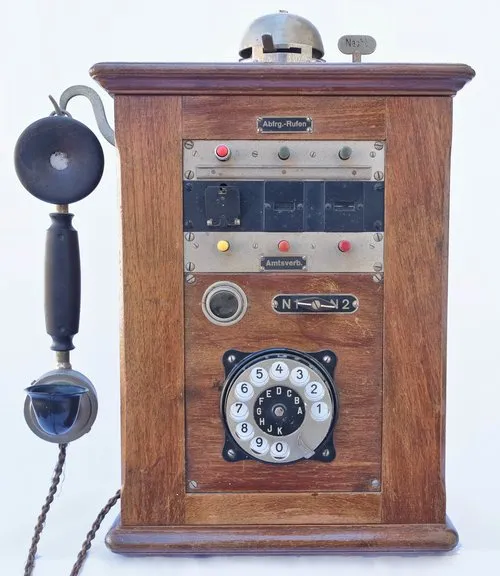
Photo: Unknown, CC0, via Wikimedia Commons
My grandmother's kitchen had two important fixtures: the yellow wall phone with the extra-long cord, and the stool she kept beside it so she could talk and stir at the same time.
If you called on a Tuesday afternoon, chances are you'd get a busy signal. Not because the line was broken — because Mrs. Delaney two houses down was on it, getting the potato salad ratio wrong again.
The Party Line Was the Original Group Chat
For much of the twentieth century, especially in small-town and rural America, telephone party lines meant several households shared a single connection. Privacy was theoretical at best. But something else happened in all that eavesdropping: recipes spread.
You'd hear a neighbor mention she'd put green chiles in her meatloaf, and by Friday, half the town had tried it. Food historian and Iowa native Ruth Ellen Church (no relation to the cookbook author of the same name) put it to me this way when I called her last spring: "The party line was the first algorithm. It served you what the community was already cooking."
There was no gatekeeping. No carefully styled photography. Just a voice, a pan on a stove, and somebody saying, "Now, you'll know it's ready when it smells right."
'A Handful' Was a Measurement of Trust
Which brings us to the most charming flaw in oral recipes: they're imprecise on purpose.
"Flour until it feels like biscuit dough." "A lump of butter the size of a walnut." "Bake until done." These instructions drove me crazy as a young cook. I wanted grams. I wanted times and temperatures.
But here's what I've come to understand: those vague measurements assumed context. When Grandma said "a handful of flour" for the dumplings, she meant her handful, in her kitchen, with the flour she'd bought at the same store for thirty years. The recipe wasn't incomplete — it was written for an audience of one, and the rest of us were just eavesdroppers.
The vagueness was also a teaching method. You couldn't follow an oral recipe by rote. You had to pay attention, ask questions, and eventually develop judgment. The recipe card that says "bake until done" was really saying: learn what done looks like.
The Bulletin Board at the Piggly Wiggly
The telephone had a partner in crime: the grocery store corkboard. Every town seemed to have one — a plywood rectangle by the register where church supper announcements mingled with mimeographed recipe swaps and a card for "Mrs. Pruitt's Angel Biscuits, free to a good home."
These boards were the message forums of their day. A woman moving into town could learn the local food culture in one visit: what the church was serving, whose pickles won at the county fair, which casserole the new bride needed to master to be truly welcome.
There's a lovely democracy to it. Nobody needed a platform or a following. You needed a recipe worth sharing and a thumbtack.
What the Search Bar Can't Give Us
I'm not here to bash the internet. I've rescued plenty of weeknights with a well-timed search. But something is different about a recipe you receive by voice.
For one, it comes with a person attached. When my mother dictates her mother's chicken and dumplings over the phone, she pauses at the part where Grandma always paused. She laughs at the memory of the time the dumplings came out like hockey pucks. The recipe arrives pre-loaded with story.
For another, oral recipes are self-selecting. Nobody dictates a mediocre dish. What survives the telling — and retelling — is only what was good enough to keep talking about. That's a tougher filter than any five-star rating.
And finally, a recipe told aloud is a conversation. You can ask what "a knob of butter" means. The search bar just repeats itself.
The Disappearing Act
Here's the part that keeps me up at night: the people who hold these recipes in their heads won't be holding them forever. Every year, thousands of dishes vanish — not because anyone decided to let them go, but because nobody thought to write them down. It seemed unnecessary. Grandma was always going to be there to call.
I've heard from readers who lost a parent and found themselves unable to recreate the one dish that defined their childhood. Not for lack of trying. The recipe lived in a voice, and the voice is gone.
Your Homework (Yes, Homework)
So here's my ask, and I mean it sincerely: this week, call someone. A grandmother, an aunt, a father, an old neighbor. Ask them for one recipe — the one they make without measuring anything.
Then write it down, in their words, vagueness and all. Include the asides. Include "you'll know when it smells right." Include the pause where they laugh.
Because "a handful" from a voice you love will always be worth more than an exact measurement from a stranger. And someday, someone will be very grateful you picked up the phone.